Bernard Films: 31 Videos, 174 Million Views, Six Months
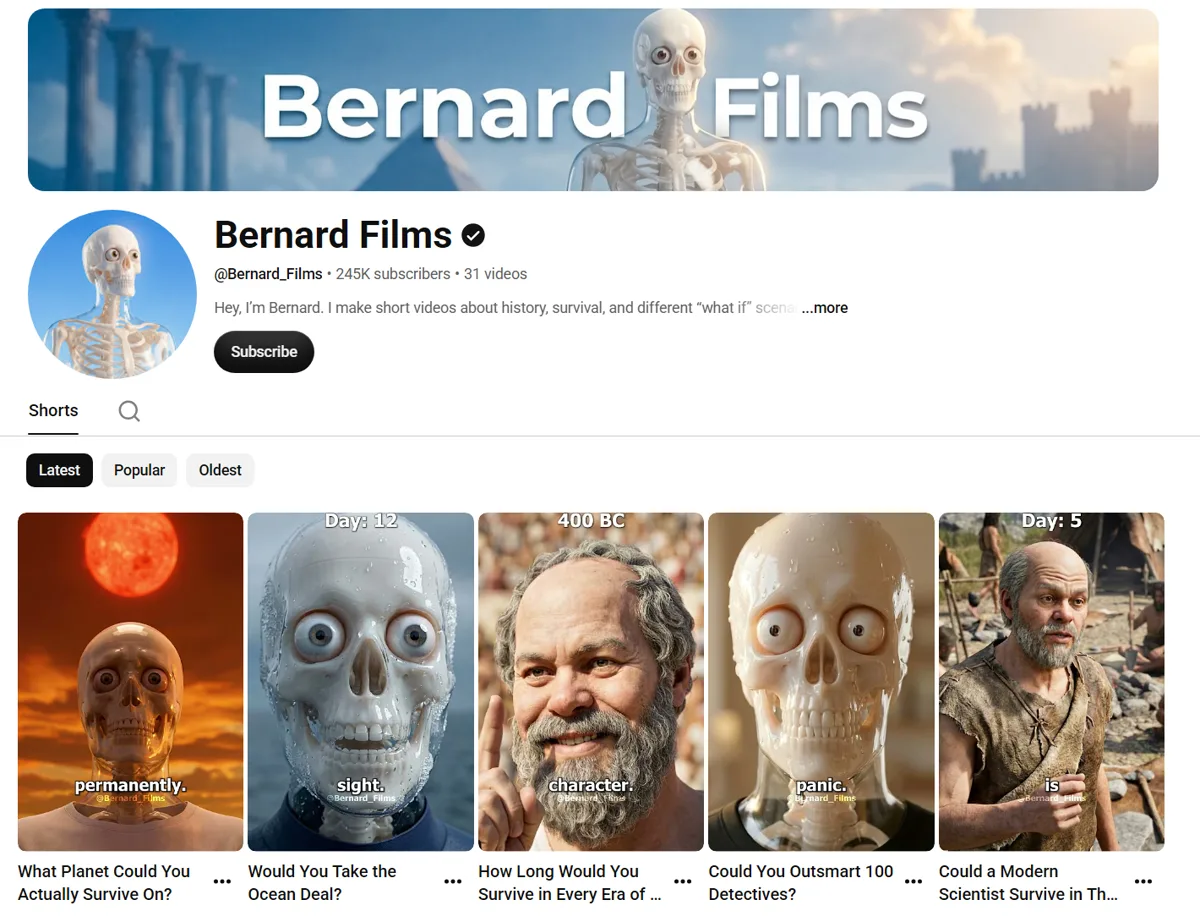
Bernard Films opened on January 24, 2026. Six months later it has 31 videos, 245,000 subscribers, and 174 million views. That is an average of about 5.6 million views per video, from a channel that uploads roughly once a week.
The channel is worth studying not because the numbers are big but because the structure behind them is unusually easy to see. Almost nothing about it is accidental.
One premise, reused about twenty times
The bio reads: "Hey, I'm Bernard. I make short videos about history, survival, and different 'what if' scenarios."
That is narrower than it sounds. Nearly every video is the same sentence with two blanks filled in: take something modern, drop it into a specific historical setting, and work out what would actually happen.
- What If You Had a Smartphone in Ancient Rome? (1.8M)
- What If You Had a Smartphone in Ancient Greece? (8.2M)
- What If You Had a Smartphone in Medieval Europe? (1.5M)
- What if You Had Steel in The Bronze Age? (10M)
- Modern Boxer vs Ancient Greece (8.3M)
- Ancient Rome vs Modern Hair (6.9M)
- Ancient Rome vs Hot Sauce (2.7M)
- Special Forces in The Medieval Ages (12M)
- Special Forces in The Aztec Empire (1.4M)
This is the part most people get wrong when they study a channel like this. They see "history content" and pick history as their niche. The actual unit of repetition is not a topic, it is a sentence shape. Bernard Films did not have to invent 31 ideas. It invented about four templates and swapped the nouns.
Notice also that the templates are run more than once on purpose. The smartphone premise ran three times. "The Smartest Way to Win in X" ran four times, across Ancient Rome, Ancient Greece, the Gold Rush, and a diamond rush. When a format works, the channel does not move on from it. It reruns it with a new setting.
The title is always a question you answer in your head
Look at the phrasing. Not "Life in Ancient Rome". Instead:
- Could You Outsmart 100 Detectives? (12M)
- Could a Modern Scientist Survive in The Stone Age? (8.5M)
- How Long Would You Survive in Every Era of History? (9.4M)
- Could You Dig to the Earth's Core? (36M)
Every one is second person and every one is a question. This does two things at once. It makes the viewer start answering before the video does, which is what stops the scroll, and it makes the comment section obvious, because everyone already has an opinion by the time the video ends. On Shorts, comments are one of the strongest signals you can generate.
A recurring character does the branding
The channel has a mascot: a translucent glass skeleton with oversized eyes. It is in the avatar, in the banner, and in a large share of the thumbnails. It functions as the viewer's stand-in, the "you" in "could you survive".
This matters more on Shorts than on regular YouTube. In a feed there is no channel page, no branding, no subscribe button in view. Recognition has to happen inside the frame itself, in under a second. A consistent character is the cheapest way to buy that. Someone who liked the Bronze Age video recognizes the skeleton three weeks later without reading a single word.
The rest of the visual grammar is just as fixed: a context label in the top corner ("400 BC", "Day: 12"), a single word of caption burned in at the bottom, and the handle watermarked underneath it. Same layout on every video.
What the numbers also say
Two honest observations, because the growth chart is not a straight line up.
Subscriber growth has flattened. Social Blade shows roughly 474,000 views in the last 30 days and effectively zero net new subscribers over the same window. This is the standard Shorts trade-off and it is worth knowing before you copy the model. Views on Shorts are cheap and subscribers are not, because the format is consumed in a feed where nobody is looking at who made it.
The weaker videos are the ones that drop the frame. The lowest performers are the ones that stop being "you, in a hostile setting" and become a general science question: This Machine Broke The Economy (412K), What Happens If You Cross a Lion And a Tiger?, the channel's first video (438K), What Happens If You Dig Through the Earth? (641K). Meanwhile the videos that keep the second-person survival framing sit between 8 and 36 million. Note that Could You Dig to the Earth's Core? at 36 million is not history at all, so the constraint is clearly the framing rather than the subject matter.
The lesson is not "stay in history". It is that the format is the asset, and drifting off it costs more than drifting off the topic.
Building the same structure in PassiveShorts
The reusable part of Bernard Films is a fixed premise plus a fixed look, held steady across every upload. That maps directly onto how a series is configured.
When you create a series, set Series Topic to Custom Topic and describe the premise rather than the subject. Then use the Custom Prompt field to lock the voice, the framing, and the recurring character. The custom prompt is applied to the narration and to every image prompt in the video, so anything you name there stays consistent from the first line to the last.
Here is what a Bernard Films style setup looks like, written out.
Custom Topic:
Hypothetical survival scenarios set in one specific historical era per video. Each video drops a modern person, object, or skill into an ancient setting and works out what would actually happen, step by step, using real historical detail.
Custom Prompt:
Narrate in second person, speaking directly to the viewer as "you". Open by restating the question in the title, then answer it within the first five words. Every image features the same translucent glass skeleton with oversized eyes standing in for the viewer, placed in the historical setting being described. Keep the tone dry and matter of fact, never hyped.
Visual Style: Photorealistic or Cinematic.
That is the whole configuration. The topic supplies the sentence shape, the custom prompt supplies the character and the voice, and the visual style supplies the finish. Every video the series generates afterwards fills in a different setting.
Three premises that are not already taken
The point of the exercise is to steal the structure, not the niche. Bernard Films already owns the history version. These use the same machinery on ground that is still open.
The deep water one.
Custom Topic: What happens to a human body and to ordinary objects at each depth of the ocean, one specific depth per video.
Custom Prompt: Narrate in second person as if the viewer is descending right now. Announce the current depth in the first line and repeat it as pressure increases. Every image features the same battered yellow diving helmet with a cracked faceplate as the viewer's stand-in. Cold, calm, clinical tone.
The trades one.
Custom Topic: How a specific everyday object was actually manufactured before industrial machinery, one object per video.
Custom Prompt: Narrate in second person as the apprentice doing the work. Open with the single hardest step and why it ruins most attempts. Every image features the same pair of scarred, soot-stained hands at a workbench, shot from the worker's own point of view. Patient, unhurried tone.
The scale one.
Custom Topic: What a familiar object or creature would do to the world if it were a hundred times larger, one subject per video.
Custom Prompt: Narrate in second person, with the viewer standing at ground level watching it happen. Give one real physical consequence per line, in order of how fast it would arrive. Every image features the same small orange traffic cone somewhere in frame for scale. Deadpan tone, no exclamation.
Each of these gives you an unlimited supply of videos, because the premise is a template and the world is full of nouns to put in it.
Before you commit to one
You do not have to guess. Write one script in the direction you are considering, paste it into the single video form with the same custom prompt attached, and watch the result. It costs one video to find out whether the character and the voice actually work together, which is a much cheaper way to test a premise than discovering the problem on video fourteen.
If it lands, put the same custom prompt on a series and let it run. If it does not, you changed a paragraph of text, not a channel.
Related reading
- 12 Faceless YouTube Channel Ideas That Still Have Room in 2026 — how to pick the ground before you build the format
- How to Automate YouTube Shorts — the mechanics of keeping a series posting
- YouTube Partner Program Shorts Requirements — what those views have to clear before they pay